Somewhere between the flat white at a century-old coffee house on Andrássy Avenue and the thermal soak at Széchenyi at sunset, you stop thinking about where else you could be living. Your rent is €550. Your monthly budget, all in, is €860. And yet you're in the middle of a European capital that genuinely surprises you every week.
Budapest is not undiscovered. The remote work community figured it out a few years ago and the word has spread. But unlike Lisbon or Bali, it hasn't been smoothed into an expat theme park. It's still a real city with real friction and real character. That's the point.
The numbers that will make you book a flight
Budapest costs €860 a month for a comfortable life in the city centre. That is not a backpacker budget. That is a one-bedroom apartment in the Jewish Quarter, eating out several times a week, thermal baths, ruin bars, and building a proper life in an EU capital. Compare that to Lisbon at €1,200, Berlin at €1,400, Amsterdam at €1,950. You are saving between €340 and €1,090 every single month.
Over a year, that is €13,000 in savings compared to Amsterdam. Which is either a business class round trip anywhere in the world, or a meaningful start to an investment portfolio, depending on your priorities.

The thermal bath situation
The city sits on dozens of natural thermal springs that the Romans built baths around 2,000 years ago. Today the Széchenyi complex in City Park, the Gellért on the Danube banks and the 16th-century Ottoman Rudas are world-famous. An annual pass to multiple baths costs €200 to €300. Post-work recovery, sorted for the year.
Picture Tuesday at 5pm. You close the laptop, hop on a tram for €0.80, and twenty minutes later you are floating in a 38°C outdoor pool as the sun sets over the city. This is not a holiday. This is the workweek.
The neighbourhoods
Jewish Quarter, 7th
Ground zero for the nomad scene. Ruin bars, excellent restaurants, a growing specialty coffee scene and the largest expat community in the city. Szimpla Kert is here.
Belváros, 5th
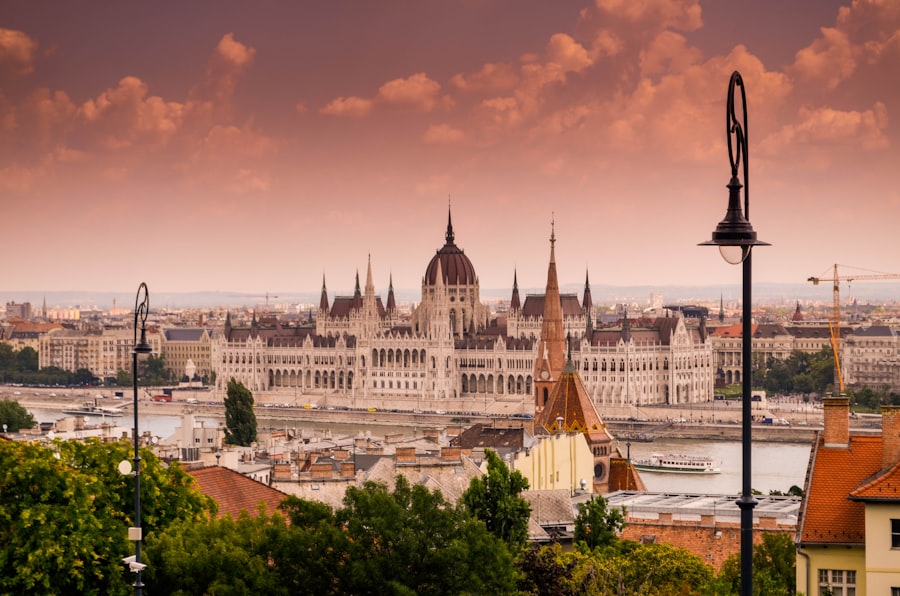
The historic centre with 19th-century boulevards and Parliament views. More expensive but extraordinary to live in. The Danube embankment is one of the great urban walks in Europe.
Ferencváros, 9th
Rapidly gentrifying, with new restaurants and cultural venues arriving monthly alongside still-affordable rents. The Great Market Hall is here. This is where the next wave is landing.
Buda hills
Quieter, leafier and more residential. Beautiful historic streets around the Castle District. Less convenient for going out but genuinely peaceful.
The food
Hungarian cuisine is underrated globally and outstanding locally. Goulash, chicken paprikash, lángos (deep-fried flatbread with sour cream), chimney cake. A meal at a local étterem runs €5 to €8. The Great Market Hall near the Liberty Bridge is spectacular and genuinely used by locals, not just tourists. The city's ruin bar scene serves beer at €1.50 to €2 in spaces that are genuinely unlike anything else in Europe.
What the numbers do not capture
Vienna is 2.5 hours by train. Bratislava is 2.5 hours. Lake Balaton, Hungary's inland sea and summer playground, is 1.5 hours. The Danube Bend north of Budapest makes for a perfect Saturday. For weekend escapes, Belgrade is 3 hours by train and Zagreb is 5 hours.
The political environment was a genuine concern for years. Viktor Orbán's government drifted towards illiberalism in ways that made many expats, and particularly LGBTQ+ residents, uncomfortable. For most remote workers it did not significantly impact daily life, but it was a real part of the conversation about Budapest.
Following the April 2026 Hungarian parliamentary elections, Fidesz lost its legislative majority for the first time in 16 years. Viktor Orbán's era in government appears to be ending. For the international expat and digital nomad community, this is significant news. The incoming coalition has signalled a return to EU mainstream positions, including stronger LGBTQ+ protections and greater media freedom. For expats who had ruled out Budapest on political grounds, this changes the calculation. Hungary remains an EU member state with a flat 15% income tax rate, one of the lowest in the bloc, and a cost of living that has no peer in Western Europe. The city's fundamentals were always exceptional. The political overhang is lifting.
Compare Budapest with other cities
See full Budapest guide